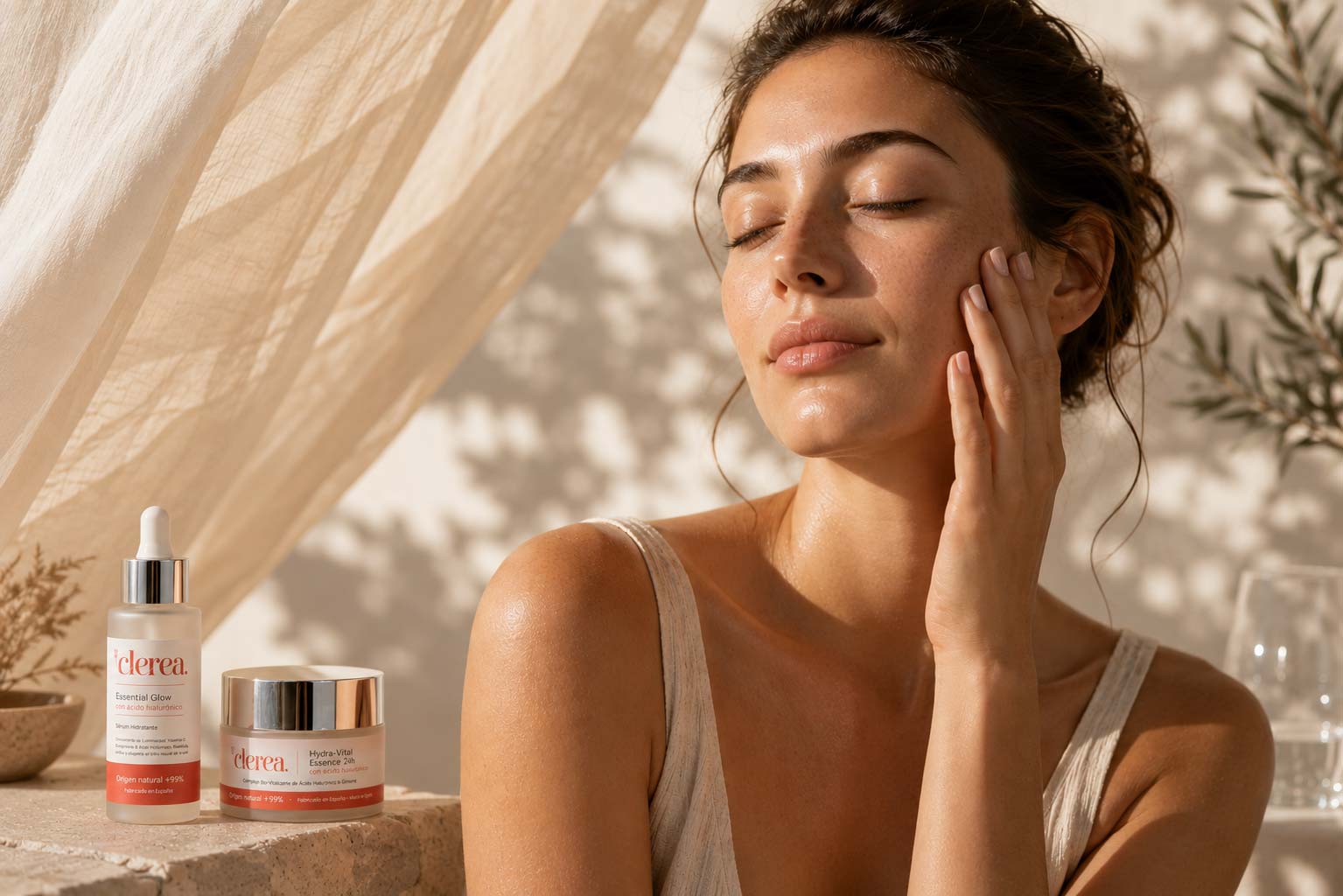
Why your skin needs more hydration in summer, even if it doesn't feel dry
When we think of summer, we usually associate it with brighter, more comfortable skin that even requires less care.
After all, the feeling of tightness typical of winter disappears, and many people feel their skin is better.
But the reality is somewhat more complex.
Although the skin may feel more comfortable during the warm months, it is also exposed to factors that promote water loss and alter its natural balance.
And this loss of hydration is not always obvious to the naked eye.
Hydration and dryness are not the same
One of the most frequent mistakes is to think that hydrated skin is simply skin that doesn't feel dry.
However, hydration refers to the skin's ability to maintain an adequate level of water in its superficial layers.
Skin can produce oil and still be dehydrated.
In fact, during the summer, it is relatively common for combination or oily skin to experience unnoticed water loss because sebum production increases with high temperatures.
The feeling of shine does not always mean balance.
What happens to the skin during summer
Summer introduces several factors that can promote skin dehydration:
Sun exposure
Solar radiation can alter the skin's barrier function and increase transepidermal water loss.
High temperatures
Heat increases the natural evaporation of water present on the skin's surface.
Sweating
Although it is a necessary physiological mechanism to regulate body temperature, intense sweating also contributes to water loss.
Air conditioning
This is one of the most underestimated factors.
Air-conditioned environments usually reduce ambient humidity and promote a feeling of dehydration without the skin necessarily feeling dry.
More frequent cleansing
During the summer, many people increase the frequency of facial cleansing to remove sweat, sunscreen, or oiliness.
When this cleansing is excessive or too aggressive, the skin can lose some of its natural balance.
Signs that your skin might be dehydrated
Dehydration does not always manifest as flaking.
Some more common signs are:
- Feeling of tightness after cleansing.
- Loss of luminosity.
- Tired appearance.
- More visible fine lines.
- Occasional sensitivity.
- Feeling of discomfort at the end of the day.
- Less uniform texture.
Often these symptoms appear progressively and become normalized without us identifying them as a lack of hydration.
Why oily skin also needs hydration
There is an idea that hydrating is equivalent to adding more oil.
However, these are different processes.
Hydration is related to the water the skin can retain, while nourishment is more linked to lipids.
When oily skin becomes dehydrated, it can even react by increasing sebum production to try to compensate for the imbalance.
The result is usually shiny but uncomfortable skin.
That's why hydration remains a necessity during the summer, regardless of skin type.
How to help maintain hydration during the warm months
It's not about using more products.
It's about choosing those that help maintain the skin's natural balance.
Some simple guidelines can make a difference:
- Use gentle cleansers that respect the skin barrier.
- Avoid excessive cleansing.
- Consistently apply hydrating products.
- Maintain responsible sun exposure.
- Adapt your routine when your skin needs it.
- Prioritize light and comfortable formulas during the day.
The key is not to overload the skin, but to support it.
Hydration is a year-round necessity
The skin does not stop needing hydration when temperatures rise.
It simply expresses that need differently.
Understanding how it responds to heat, sun, or environmental changes allows for building a more coherent routine that respects its real needs.
Because balanced skin is not necessarily the skin that receives the most products.
It's the skin that receives exactly what it needs at all times.